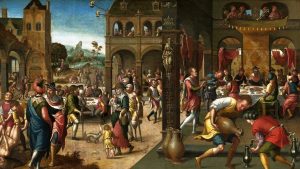
I hesitate to grapple with today’s Bible readings. They deal with judgment and punishment and, writing this in the week before the Inauguration, I don’t want to go there. But in the parable of poor Lazarus, sitting outside the gate and unwelcome in the rich man’s home, I see an opening.
THE GUEST
Historically, the Church of the Ascension was open 24/7. It’s not feasible to do that these days, but we’re trying to open the doors on weekdays from 12:00-3:00. This is possible only when we have a volunteer at the door. So far, we have a small, dedicated crew, but we need more volunteers to meet the modest goal of three hours each day. I urge and recommend this “service” for more reasons than there is space here to rhapsodize, but corner me in coffee-hour and I’ll talk your ear off! For our visitors — whether neighbors or travelers — being in Ascension packs a wallop. In addition, there is never a day at the door when I walk away unmoved, unimpressed, uninformed in some way by our guests.
THE HOST
While I was door-sitting one Tuesday, a family came in, visiting from Italy. The dad looked around and asked, “Where is the host?” Though at first confused, I then had an epiphany: Oh, that Host! I did not, at that time, realize the tabernacle box on our own side altar holds the reserve sacrament. But no matter: more important, this visitor and I had an opportunity for a friendly discussion of Christians’ varying views on Holy Communion. He was Roman Catholic and understood the sacraments in the context of that church’s doctrine of transubstantiation. And many Episcopalians also discern a similar (or less-defined but no-less-real) presence of Christ’s body and blood in the bread and the wine. Growing up at Ascension in (what was then called) the Protestant Episcopal Church, I tend to understand Communion best as sharing a holy feast, memorializing Jesus’ followers’ shared meal in the Passover Seder, which Christians call the Last Supper. But I had never thought much about these differences — perhaps owing to our Anglican tradition of offering wide latitude in devotional practices. Such variation was news to this devout Catholic man, however, as we searched for words in the other’s language to express and comprehend. I didn’t learn what he thought about my view of the Eucharist, but I was surprised to recognize in myself shades of bias I might have inherited from my own “fallen-away Catholic” father.
A falling-away … from judgment; an opportunity to represent and receive the church, also known as the Body of Christ … at our door.